What does restaurant influencer marketing cost in the UK?
Two quotes for the same thing can differ by a factor of ten, and usually it is because they are not quoting the same thing at all. Here are the UK benchmark ranges for 2026, and the layer most quotes leave out entirely.
By Abdirahman Mohamud, Founder, Rihla Reach · 25 August 2026
Most published figures for this are American, converted badly, and quoted for creator tiers no independent restaurant should be hiring. The numbers below are UK market benchmarks for 2026, cross-checked between published sources where possible. They are context for judging a quote, not one agency’s rate card.
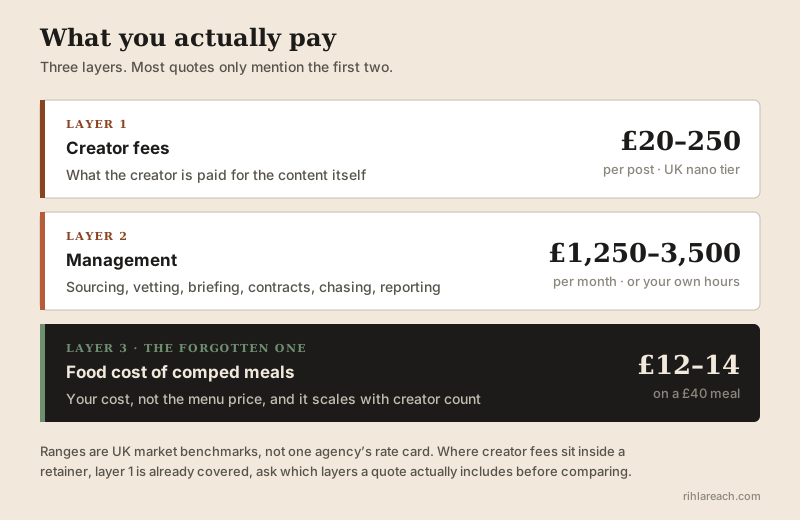
The useful frame is that there are three separate layers, and almost every argument about price is really a disagreement about which layers are included.
Layer one: what creators actually charge
UK published rate cards for 2026 land roughly here. Ranges overlap because rates depend on format, exclusivity and usage rights as much as on follower count. Tier boundaries themselves vary between sources. The table below is cross-checked against two published UK cards (sources 1 and 2): the full range in a row spans what both report, and where a narrower band is called out, that is where the two agree most closely, so the spread stays honest rather than implying a precision neither source actually has:
| Tier | Followers | Per post (UK, 2026) |
|---|---|---|
| Nano | 1,000–10,000 | £20–£250 · most sources overlap at £50–£150 |
| Micro | 10,000–50,000 | £250–£1,000 |
| Mid-tier | 50,000–250,000 | £1,000–£5,000 |
| Macro | 250,000–1,000,000 | £5,000–£15,000 |
Three things move a nano rate within that band. Format: a filmed Reel or TikTok takes hours of shooting and editing, so it costs more than a static post, and Stories cost least. Usage rights: the moment you want to run the content as a paid advert, or keep using it beyond a set window, the price rises, and it should, because you are buying something materially different. Exclusivity: asking a creator not to post about a competing restaurant for a period is a real constraint on their income.
For a single-location restaurant, the nano row is the relevant one. Reach outside your own city is mostly wasted spend, which is covered in more detail in the vetting guide.
Layer two: management, or your own hours
This is the layer people underestimate, because when you do it yourself it does not appear on any invoice. Sourcing candidates, checking them properly, negotiating, writing briefs, issuing contracts, chasing people who go quiet, collecting the content, and putting numbers together at month end is real work, and it recurs every month.
If you buy that labour instead, UK agency retainers for a single channel commonly run £1,250–£3,500 a month, with full-service mandates considerably higher. Influencer-specific retainers vary widely with scope.
A retainer number on its own tells you almost nothing. Before comparing two, ask: how many creators and how many pieces of content per month; are creator fees included or billed separately; what is the minimum term; is there a separate onboarding or setup fee; and who owns the content afterwards. Two “£2,000 a month” quotes can differ by triple the actual deliverables.
Layer three: the food cost nobody quotes
Every comped visit costs you a meal. Not the menu price: your food cost, which for most restaurants runs 30–35% of menu price. A £40 meal costs you roughly £12–£14.
That is genuinely modest per visit, which is why it gets waved away. The problem is that it scales with creator count and it is invisible in every quote you will receive. Six creators a month is somewhere around £72–£84 in food cost; if each brings a guest, double it. Over a six-month term that is a real line item that never appeared in the proposal.
Budget it explicitly, and make sure you know whether the creator is bringing someone.
The three models you will be quoted
Platform subscription, from around £300/month. You get access to a creator roster and tooling. You still do the sourcing, vetting, briefing and chasing, and creator fees are usually separate. Cheapest on paper; cheapest only if your time is free.
Managed retainer, roughly £1,250–£3,500/month for a single channel. Someone else does the labour. Whether creator fees sit inside or outside the retainer is the single most important question to ask, and it swings the true cost enormously.
Per-campaign or per-creator. Flexible and easy to trial, but the per-unit cost is usually highest, and campaigns judged over a single month rarely show the patterns worth judging.
None of these is wrong. They price different things. A platform subscription genuinely is cheaper if you have someone in-house who will do the work properly and consistently, and considerably more expensive if that work quietly does not happen.
What is a sane budget?
Two reference points. UK independent restaurants spend roughly £800–£2,500 a month on all marketing combined, and a widely repeated rule of thumb puts total marketing spend at 3–6% of gross revenue, a convention rather than the finding of any trade body or study.
A practical test: does the monthly fee stay under about 7–8% of your monthly revenue? At £25,000 a month, a £1,500 retainer is 6%, workable. At £10,000 a month it is 15%, which is not a pricing problem so much as a signal that the venue is too small for that tier right now.
Be wary of any agency that does not ask about your revenue before quoting. The ratio matters more than the headline number, and an agency that skips it is not thinking about whether the engagement can actually work.
Two costs that only show up later
No-shows. Gifted-only arrangements deliver far less often than restaurants expect. In Modash’s 2026 gifting survey of 74 marketers, 90.5% said creators ghost gifting campaigns more often than any other kind of collaboration, and posting was reported as more consistent under barter deals than under no-strings gifting, 50% against 43.8%. Read those as marketers’ reported experience, not a measured posting rate: nobody publishes a clean one for comped restaurant visits. The point stands without a precise figure, because the food cost is spent the moment the meal is served, whether or not anything is ever posted. Contracts and payment on verified delivery are what remove this, which is the entire argument for paying creators rather than only feeding them.
Usage rights you did not buy. Organic posting rights and paid-advertising rights are different products. If you later want to put a creator’s video behind ad spend and it was not in the original agreement, you renegotiate from a weak position. Decide up front, even if the answer is no.
Common questions
How much does a nano-influencer charge per post in the UK?
UK published rate cards for 2026 put nano creators, roughly 1,000 to 10,000 followers, at about £20 to £250 per post, with most of the overlap between sources sitting around £50 to £150. Rates climb with production demands: a filmed Reel or TikTok costs more than a static post, and exclusivity or paid-ad usage rights raise it again.
What should a UK restaurant budget for influencer marketing each month?
As context, UK independent restaurants spend roughly £800 to £2,500 a month on all marketing combined, and a widely repeated rule of thumb puts total marketing spend at about 3 to 6 percent of gross revenue, though that figure is convention rather than the finding of any trade body or study. A managed influencer programme usually sits inside that envelope rather than on top of it, so a useful test is whether the fee stays under about 7 to 8 percent of monthly revenue. If it does not, the venue is probably too small for that tier.
Is a free meal cheaper than paying a creator?
It is cheaper per booking and considerably less reliable. In Modash’s 2026 gifting survey of 74 marketers, 90.5 percent said creators ghost gifting campaigns more often than any other kind of collaboration, and posting was reported as more consistent under barter deals than under no-strings gifting, 50 percent against 43.8 percent. Those are marketers’ reported experience rather than a measured posting rate, and no one publishes a clean one for comped restaurant visits, so plan for a real failure rate rather than a precise number. The meal is also not free to you: it costs food cost, typically 30 to 35 percent of menu price, so a £40 meal costs roughly £12 to £14, and you pay it whether or not anything is posted.
Why do influencer marketing quotes vary so much?
Because they often cover different layers. A platform subscription from around £300 a month typically gives you access to a creator roster while you do the sourcing, briefing and chasing yourself, and creator fees are usually separate. A managed retainer covers the labour and often the creator fees too. Before comparing two numbers, ask which of the three layers each one includes: creator fees, management, and whether the food cost of comped meals has been accounted for at all.
What does a managed influencer marketing retainer cost in the UK?
UK agency retainers for a single channel commonly run about £1,250 to £3,500 a month, with full-service mandates considerably higher. Influencer-specific retainers vary widely with scope. The number on its own means little without knowing the deliverable count, whether creator fees are included, what the minimum term is, and whether a separate onboarding fee applies.
Sources
Every external figure on this page, with the source it came from. Last checked 2026-08-27.
- Influencer Rates UK 2026: Rate Card by Platform, Aether Agency.Supports: the per-post rate bands in the tier table above.
- Marketing Retainer Cost UK 2026, Whito.Supports: the £1,250–£3,500 a month single-channel agency retainer range, and the lower end of the nano per-post band cross-checked against source 1.
- How Much Does Restaurant Marketing Cost in the UK?, Primewise.Supports: the £800–£2,500 a month total marketing spend range for UK independents.
- How Much Should a Restaurant Spend on Marketing? 2026 UK Benchmarks, Super44.Supports: the 3–6% of gross revenue figure, and the caveat that it is industry convention rather than the finding of a trade body or study.
- The State of Influencer Gifting in 2026 [Survey Data], Modash, 22 May 2026, survey of 74 marketers.Supports: the 90.5% ghosting figure and the 50% against 43.8% barter-versus-gifting posting comparison.
Where we sit, for transparency
Our own retainers are £1,500, £2,500 and £4,500 a month with creator fees included, plus a one-time onboarding fee and a minimum term, all published on the pricing section rather than quoted on request. That places Starter and Growth inside the single-channel band above. Premium runs two platforms rather than one, so it sits just above that band and inside the wider range for multi-channel retainers. We have shown you the benchmarks so you can check that for yourself, including against agencies that are not us.
See if I can help